
Views: 0 Author: Site Editor Publish Time: 2026-01-29 Origin: Site


Imagine pouring hot coffee into a plain black mug and watching a hidden image slowly materialize like a magic trick. The "reveal" moment—the transition from a standard dark exterior to a personalized photo—creates an immediate emotional impact that standard gifts rarely achieve. This element of surprise makes these items a favorite for birthdays, pregnancy announcements, and office pranks. However, the excitement can quickly fade if the execution is poor. A mug that reveals its secret before the hot water hits, or one that peels after a week, turns a thoughtful gesture into a disappointment.
The reality is that quality varies significantly between vendors. While the concept is simple, the manufacturing process involves precise thermal coatings and specialized printing techniques. Not all "magic mugs" are created equal. Some suffer from "ghosting," where the image is visible through the cold layer, while others lack the durability to survive daily use. This guide covers high-impact design ideas, technical evaluation criteria to avoid transparency issues, and the strict maintenance requirements necessary to ensure your gift lasts for years. By understanding the mechanics behind these products, you can ensure the surprise remains genuine.
The Mechanics: Mugs use thermochromic ink that becomes transparent at approximately 40°C (104°F); they are not electronically powered.
The "Ghosting" Risk: Lower-quality mugs may not be fully opaque when cold, slightly revealing the surprise element prematurely.
Design Strategy: High-contrast photos and "before/after" text concepts work best; avoid dark images that blend into the black coating.
Strict Care Required: Unlike standard ceramic photo mugs, color change mugs are Hand Wash Only and typically Not Microwave Safe due to the sensitive coating.
Before designing your artwork, it is helpful to understand the science that powers these unique gifts. Contrary to popular belief, there are no electronics or batteries embedded in the ceramic. The effect is entirely chemical, relying on a specific type of material known as leuco dyes.
The core technology behind color change mugs is a layer of thermochromic ink. This heat-sensitive coating is applied over the standard sublimation print. In its cold state, the molecules in the ink are solid and opaque, effectively blocking the light from reaching the image printed underneath. This is why the mug appears black, blue, or red when it sits in your cupboard.
When heat is applied, the molecular structure of the coating changes. The solid crystals melt into a liquid-crystal state, allowing light to pass through. This renders the top layer transparent, revealing the permanent image baked into the ceramic surface below. Once the liquid cools down, the crystals reform, and the mug returns to its original opaque color.
The "magic" requires a specific temperature trigger. For most standard industry mugs, the activation threshold is approximately 40°C (104°F). This temperature was chosen specifically because it matches the typical serving temperature of hot beverages like coffee, tea, or hot cocoa, without requiring boiling water that might be unsafe to drink.
It is important to note that the mug itself absorbs heat. If you pour a small amount of hot liquid into a thick, cold ceramic mug, the liquid may cool below the threshold before the image fully reveals. For the best effect, filling the mug to the brim with very hot liquid ensures a rapid and complete transition.
While black is the industry standard for maximum concealment, you might encounter other options. However, darker base colors always perform better than lighter ones.
Black Base: The most effective option. It absorbs the most light and offers the highest level of surprise.
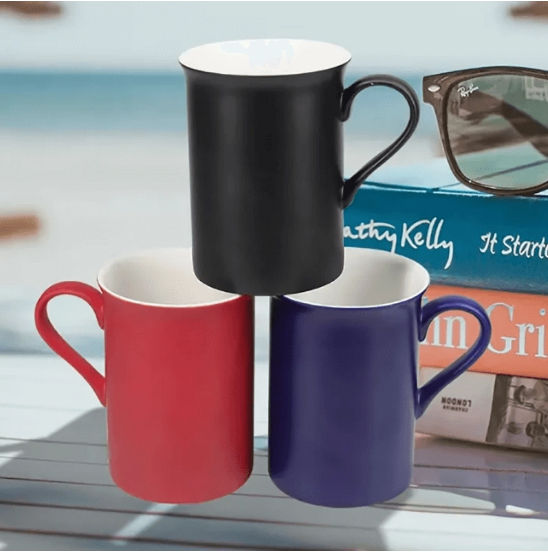
Blue or Red Base: These are available but often suffer from higher transparency. The hidden image is frequently visible even when the mug is cold, spoiling the surprise.
Beyond color, the texture of the finish plays a massive role in the final look. You will generally choose between Matte and Glossy finishes.
| Feature | Matte Finish | Glossy Finish |
|---|---|---|
| Concealment | Excellent. The flat texture absorbs light, making the hidden image nearly invisible. | Moderate. Bright light can reflect off the surface, sometimes revealing the outline of the photo underneath. |
| Visual Appeal (Cold) | Understated and modern. Looks like a slate or chalkboard texture. | Traditional ceramic look. Appears more vibrant but less mysterious. |
| Durability | Slightly more prone to showing scratches from spoons or rings. | Harder surface that resists minor surface scratches better. |
| Best Use Case | Surprise reveals and pranks where secrecy is paramount. | Photo collages where a high-shine finish is preferred over total surprise. |
The success of a custom color changing mug depends heavily on the creativity of the design. A simple family portrait is nice, but utilizing the transformation mechanic elevates the gift from a simple keepsake to an interactive experience. Here are several concepts that maximize the "before and after" effect.
This category relies on the disconnect between the external appearance and the hidden reality. These are perfect for office Secret Santa exchanges or gag gifts for friends.
The "I'm Fine" Concept: The mug appears plain black or features text saying "Monday Morning Mood." When heated, it reveals a chaotic photo, a screaming possum, or a funny face of the recipient.
The Sobriety Test: Exterior text reads "I am not drunk." As the heat rises, the underlying image reveals a blurry, unflattering photo from a party or a humorous "mugshot" style picture.
Because the reveal happens slowly, these mugs are excellent vehicles for delivering big news. The delay creates suspense, and the shared moment becomes a memory.
Pregnancy Reveals: A standard-looking mug is given to a future grandparent. As they pour their tea, an ultrasound scan appears along with the text "Coming Soon."
Proposals: The text "Will You Marry Me?" is hidden beneath the black coating. This allows for a private, intimate proposal over morning coffee.
Gender Reveals: The mug starts black and turns either bright pink or blue to announce the gender of a baby.
These designs use the state change to tell a story or show progression. The cold state represents one reality, and the hot state represents another.
Before and After Coffee: A classic but effective trope. The cold mug might show a sleeping or grumpy character. The hot mug reveals the same character with wide-open eyes and high energy.
Cosmic Reveals: A simple black mug (representing the void of space) heats up to reveal a detailed map of the solar system, a nebula, or specific constellations. This utilizes the black base naturally rather than fighting against it.
Battery Charging: A "low battery" icon printed on the black surface (cold) aligns with a "fully charged" green battery icon that appears when hot.
Companies can use the reveal mechanic for internal morale or client gifts. A plain black mug on a desk looks professional and unobtrusive. However, when used during a team kickoff, it can reveal the new company mission statement, Q4 targets, or a motivational quote. This adds a layer of engagement to otherwise standard corporate merchandise.
Consumers often encounter issues with print-on-demand products, and color change drinkware is particularly susceptible to quality variations. Knowing what to look for helps you avoid embarrassment when the recipient opens their gift.
Ghosting refers to the phenomenon where the hidden image is visible through the coating even when the mug is completely cold. This ruins the surprise. It occurs for two reasons: either the thermochromic coating is too thin, or the underlying image is too bright and high-contrast for the coating to fully mask.
To mitigate this, prioritizing a Matte finish is the most effective technical step. The lack of gloss refracts light in a way that helps hide the image. Additionally, check vendor reviews specifically for "transparency" or "see-through" complaints. If user photos show the image clearly on a cold mug, avoid that vendor.
A major aesthetic differentiator is the print area. Standard printing presses often cannot print near the handle due to the mechanical clamp that holds the mug in place. This results in a "Standard Wrap," which leaves a wide vertical white gap on either side of the handle. On a white mug, this is barely noticeable. On a color change mug, which is black, a white strip near the handle breaks the illusion immediately.
The Upgrade: Look for vendors who offer "Full Wrap" or "Handle-to-Handle" printing. While there will always be a tiny margin near the handle, high-quality manufacturing minimizes this gap significantly, maintaining the illusion of a solid black object.
Peeling is the second most common failure point. The thermochromic layer is a polymer coating. If the manufacturing process is rushed or if the curing temperature isn't precise, this coating can chip, especially around the rim where lips touch the mug.
Ensure the vendor uses dye-sublimation, where the ink is heat-infused into the polymer coating, rather than a surface transfer sticker. Sublimation ensures the image is part of the coating itself. While you cannot test this online, reading reviews about "chipping rims" or "flaking paint" is a crucial vetting step.
Even the highest quality mug cannot save a low-quality image. Because the image is viewed through a specialized coating, the technical requirements for your upload are stricter than for a standard photo print.
Pixelation looks worse on ceramic than it does on paper. Aim for a print resolution of at least 300 DPI (dots per inch). For a standard 11oz mug, the full wrap print area is roughly 8.5 inches by 3 inches. In pixels, your canvas should be approximately 2400 x 975 pixels. If you upload a small image downloaded from social media (often compressed), the result will be blurry and jagged.
This is a pro tip that most basic tutorials miss: the transparent coating acts as a slight filter. Even when the mug is fully hot and the coating is transparent, it can slightly dim the image compared to a naked white ceramic mug. Dark photos will look muddy and indistinguishable.
Advice: Before uploading, edit your photo to increase the brightness and contrast by about 10-15%. Avoid photos with heavy shadows or night shots, as they will not "pop" against the black surroundings of the mug.
Ceramic mugs are tapered at the top and bottom, and heating elements in the press sometimes don't reach the extreme edges evenly. Placing text or crucial faces right at the rim can lead to distortion or fading.
Keep all critical elements—text, logos, and faces—at least 0.5 inches away from the top and bottom edges. This "safe zone" ensures that the most important parts of your design are printed clearly and heated evenly during the reveal.
The trade-off for the "magic" effect is convenience. While standard ceramic mugs are robust workhorses, color change mugs are delicate specialty items. Managing expectations regarding care is essential for the gift recipient.
There is no ambiguity here: Dishwashers destroy color change mugs. The environment inside a dishwasher combines high prolonged heat with abrasive detergents. This combination chemically strips the thermochromic layer. After just a few cycles, the black coating may peel off in sheets, or it may lose its ability to change color entirely, leaving the mug permanently stuck in a semi-transparent grey state.
Standard ceramic is microwave safe, but the thermochromic coating often is not. Microwaves heat unevenly and intensely. This localized heat can scorch the coating, causing the image to degrade or, in rare cases, causing the metallic elements in certain low-quality inks to spark. Unless the bottom of the mug explicitly states "Microwave Safe" (which is rare for magic mugs), assume it is not.
Even with hand washing, the magic effect is not eternal. The leuco dyes are sensitive to UV radiation. If a color change mug is left on a sunny windowsill for months, the UV rays will break down the chemical bonds in the dye, causing the "black" covering to fade to a dull grey or brown. To maximize the lifespan, store these mugs in a dark cupboard when not in use. With proper hand washing and UV protection, the effect can last for years.
Custom color change mugs offer a high return on investment in terms of emotional impact. The "reveal" creates a memorable moment that standard photo gifts simply cannot replicate. Whether used for a humorous prank, a romantic proposal, or a clever marketing tool, the transformation adds a layer of engagement to a daily ritual.
However, this impact comes with a trade-off in convenience. The recipient must be willing to hand wash the item to preserve the magic. When selecting a vendor, prioritize those offering matte finishes to minimize ghosting and full-wrap printing for a premium look. By choosing a high-contrast, bright image and following strict care guidelines, you create a personalized gift that genuinely feels like magic.
A: With proper care, the effect can last for many years. The critical factors are avoiding the dishwasher and minimizing exposure to direct sunlight. UV rays are the biggest enemy of the thermochromic coating and will eventually cause the black covering to fade if the mug is left in the sun repeatedly.
A: Generally, no. While the ceramic mug itself won't break, the intense heat of a microwave can damage the sensitive thermochromic coating. This can ruin the image or cause the coating to bubble. Always check the specific manufacturer's stamp on the bottom, but err on the side of caution.
A: This phenomenon is called "ghosting." It occurs if the thermochromic coating is too thin or if the hidden image is exceptionally bright. It is difficult to eliminate 100% of ghosting in very bright light, but choosing a mug with a matte finish rather than a glossy one significantly helps conceal the image.
A: The industry standard is the 11oz ceramic mug, which stands approximately 3.75 inches tall. This is the classic coffee mug size. Some vendors offer larger 15oz versions or latte-style conical shapes, but the 11oz cylinder is the most common format for custom printing.


